What the Hell Is an Advocate? (And Why Winning Brands Are Obsessed With Them)
a great customer and an advocate are not the same animal, and the brands pulling away from the pack right now have figured out the difference. They are obsessed with it. Here is why.
What the Hell Is an Advocate?
Ask ten founders to name their best customer and nine of them will name the one who spends the most.
It is the wrong answer. Not a little wrong. Structurally wrong, in a way that quietly caps how fast a brand can grow.
Your highest spender is a great customer. But a great customer and an advocate are not the same animal, and the brands pulling away from the pack right now have figured out the difference. They are obsessed with it. Here is why.
Satisfied is not the same as sold
A satisfied customer buys again. That is the whole transaction. They liked the product, the product did its job, they come back. Good. You want a list full of them.
But satisfaction is a private feeling. It lives between the customer and the product. It does not travel.
An advocate is something else entirely. An advocate does not just like your product. They see themselves in your brand. The brand says something about who they are, and so telling other people about it is not a favor to you, it is an expression of them. That is the unlock. Satisfaction makes someone buy again. Identity makes someone bring the whole group.
One repeats. The other recruits.
This is the line most brands never cross because they measure the wrong thing. They track who buys the most and pour their loyalty budget into rewarding repeat purchase. Repeat purchase is fine. It is just not the behavior that grows a brand on its own momentum. Recruitment is.

Why an advocate is worth more than the math suggests
Run the numbers the obvious way and an advocate looks like any other customer. Same average order value, maybe. Same purchase frequency, maybe.
The obvious way misses the entire point, because an advocate's value is not in what they spend. It is in what they move.
Paid acquisition rents attention. You pay, the attention shows up, you stop paying, it leaves. An advocate owns attention you could never buy, because their recommendation carries something an ad never will: belief, from someone the listener already trusts. Their word travels into rooms your budget cannot enter. A single believer talking to the right ten people outperforms ten thousand impressions, because those ten people were pre-qualified by the one relationship that mattered.
This is why advocate-rich brands grow on a curve that looks impossible from the outside. They are not outspending anyone. They have a layer of customers doing the most expensive part of marketing for free, and doing it better than money can.
The signal: advocates show their hand early
Here is the practical part, the thing you can act on this week.
Advocates announce themselves long before they ever fill out a referral form or tag you in a launch post. The behavior shows up early and it shows up in places most brands are not looking.
They reply to your emails like they are talking to a friend, not a company. They tag you unprompted, in the wild, in a story you never asked them to post. They pre-order the collaboration before they even fully know what it is, because they trust the brand enough to buy on faith.
None of that shows up in a revenue report. It shows up in behavior, scattered across your inbox, your social mentions, your early-access lists. The signal is there. It is just not in the place you are trained to look, which is the spreadsheet that ranks people by dollars.
Why you cannot see them in your dashboard
This is the real problem, and it is not a data problem. It is a synthesis problem.
You are not missing the information. You have it. The replies are in your email platform. The tags are in your social tool. The purchase history is in Shopify. The engagement is in Klaviyo. Every piece of the picture exists somewhere in your stack right now.
It is just scattered across five systems that do not talk to each other, and no single dashboard was built to assemble it into a person. So your tools count dollars, because dollars are easy to count, and they stay blind to belief, because belief lives in the pattern across all of it. The 15 percent of customers who drive the majority of your revenue and almost all of your word of mouth are sitting in the gap between your tools, where nobody is reading.
That gap is the whole game.
How you actually find them
You find them by scoring your customers on who they are, not just on what they spent.
The starting point is RFM, recency, frequency, monetary value. It is a real method and it gets you close. It will surface the people who buy often and recently and a lot. That is a useful first cut and most brands never even do this much.
But RFM still only sees behavior in dollars. It cannot tell the difference between a quiet high-spender and a loud believer who spends moderately but brings six friends. To see that, you have to add psychographic signal, the layer that reads identity and not just transaction. Who sees themselves in the brand. Who treats it as a statement about who they are. That is the read that separates the satisfied from the advocates, and it is the read your dashboard was never built to make.
Do both and the output is not another spreadsheet. It is a named cohort. A specific, recognizable group of people you can picture, describe, and build for.
What to actually do with them once you have them
Finding them is not the payoff. Building for them is.
Once you have a named cohort of advocates, three moves change everything.
First, seed to the believers before anyone else. When you drop something new, the advocates go first, not as a marketing tactic but as a structural one. They are the people most likely to carry it outward, so you put the spark where the fire already is. Their reaction becomes the proof that pulls everyone else in.
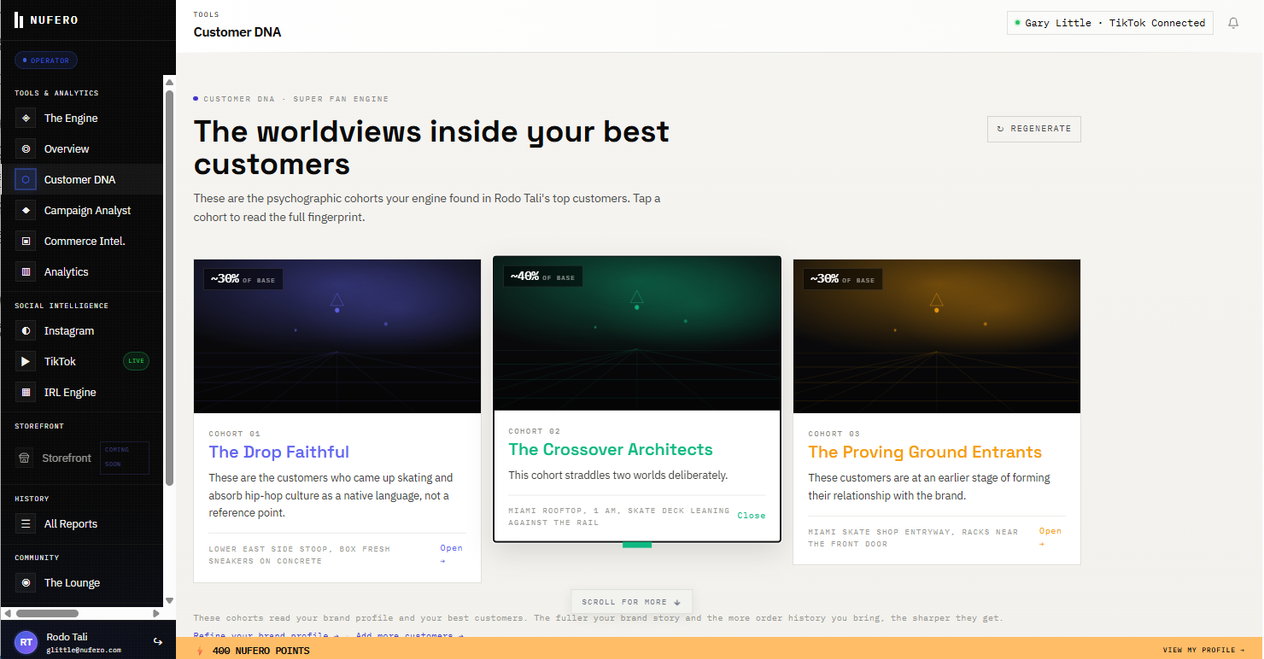
Second, make content that looks like them, not at them. Most brand content is aimed at an imagined average customer who does not exist. When you know who your advocates actually are, their references, their aesthetic, the world they belong to, you can make work that reflects them back to themselves. People share what feels like them. That is the difference between content that gets a like and content that gets reposted into someone's own feed as a statement of identity.
Third, treat the 15 percent as the engine, not the afterthought. Most brands build for the masses and hope a few superfans fall out of it. Flip it. Build for the advocates first, design the drops, the campaigns, and the world around them, and let the masses follow the gravity the believers create. The advocates are not a segment you reward at the end. They are the flywheel you build around from the start.
That is what winning brands understand that everyone else misses. The advocate is not a nice-to-have at the bottom of the loyalty funnel. The advocate is the growth strategy.
The payoff
So, what the hell is an advocate?
It is the customer who would tell the story of your brand even if you never paid them, never asked them, never knew their name. They are already in your list. They are already replying, tagging, pre-ordering, believing. The only thing missing is that you cannot see them yet, because the signal is buried across systems that were never built to read it together.
Name them, and you stop renting growth and start compounding it.
That is the work. We built a tool that does the naming.
Find the 15 percent already selling for you. A Customer DNA Snapshot reads your own customer data and surfaces your advocate cohort by name. 48-hour turnaround, a 30-minute strategy call, no pitch. Start at nufero.com/free-audit.