We Read Your Brand. Then We Build This.
A Read tells you who your customers really are. What happens next is the fun part. Two full campaign rollouts, placement by placement, and how each one is built to move product.
Every agency says it has a process. Most of them mean a slide with four circles on it. So here is ours, with the receipts: two campaigns, every surface laid out, and a straight answer on how pretty pictures turn into money.
First, a Quick Word on the Read
A Read is where we start. Before a single pixel gets pushed, we dig into who is actually buying from a brand, who keeps coming back, what they respond to, and where the brand is leaving money on the table. Think of it as the diagnosis. Nobody wants a prescription from a doctor who skipped the exam.
The Read gives us the point of view. The campaign is what we do with it.
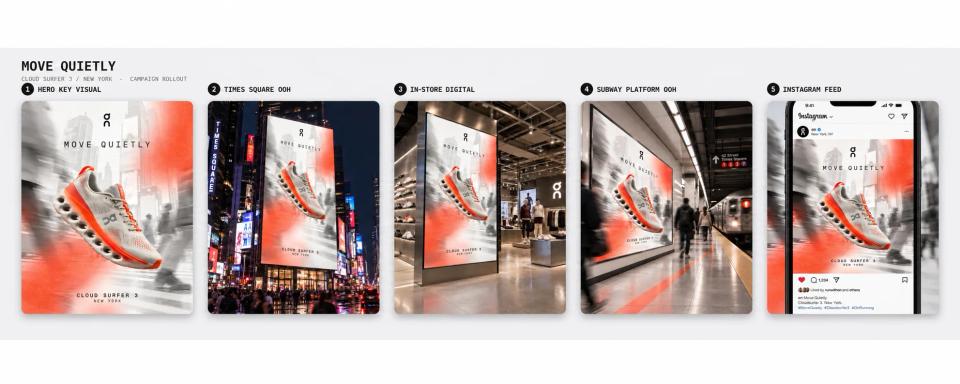
Breakdown One: Move Quietly
Picture a running shoe launching in New York. Loud city, loud category, everybody screaming "fastest" and "lightest." So the idea goes the other way: Move Quietly. A blur of commuters in black and white, one streak of hot orange, and a shoe sitting calm in the middle of the chaos. (This one is a concept we built to show the system. It is not affiliated with the brand.)
Five placements, five jobs:
- Hero key visual. The master image. Everything else is cut from this, so it carries the idea, the product, and the line all at once.
- Times Square OOH. The big swing. Pure fame. Nobody buys a shoe from a billboard, but everybody remembers who owned the block.
- In-store digital. The same image, now inside the shop. A memory from the street meets a product on the shelf.
- Subway platform OOH. Repetition at commuter pace. Whoever saw it Monday in Times Square sees it again Tuesday on the platform. Frequency is how "oh nice" becomes "I want those."
- Instagram feed. Where the idea becomes a save, a share, a tap, a conversation.
One idea, five jobs: awareness, fame, store traffic, repetition, engagement. Nothing on that board is there by accident.
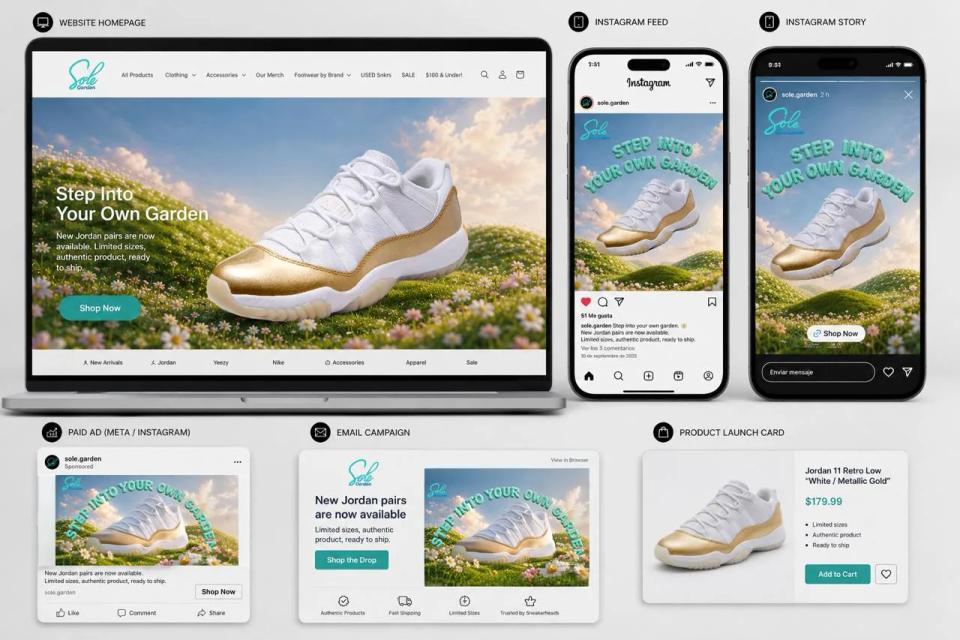
Breakdown Two: Step Into Your Own Garden
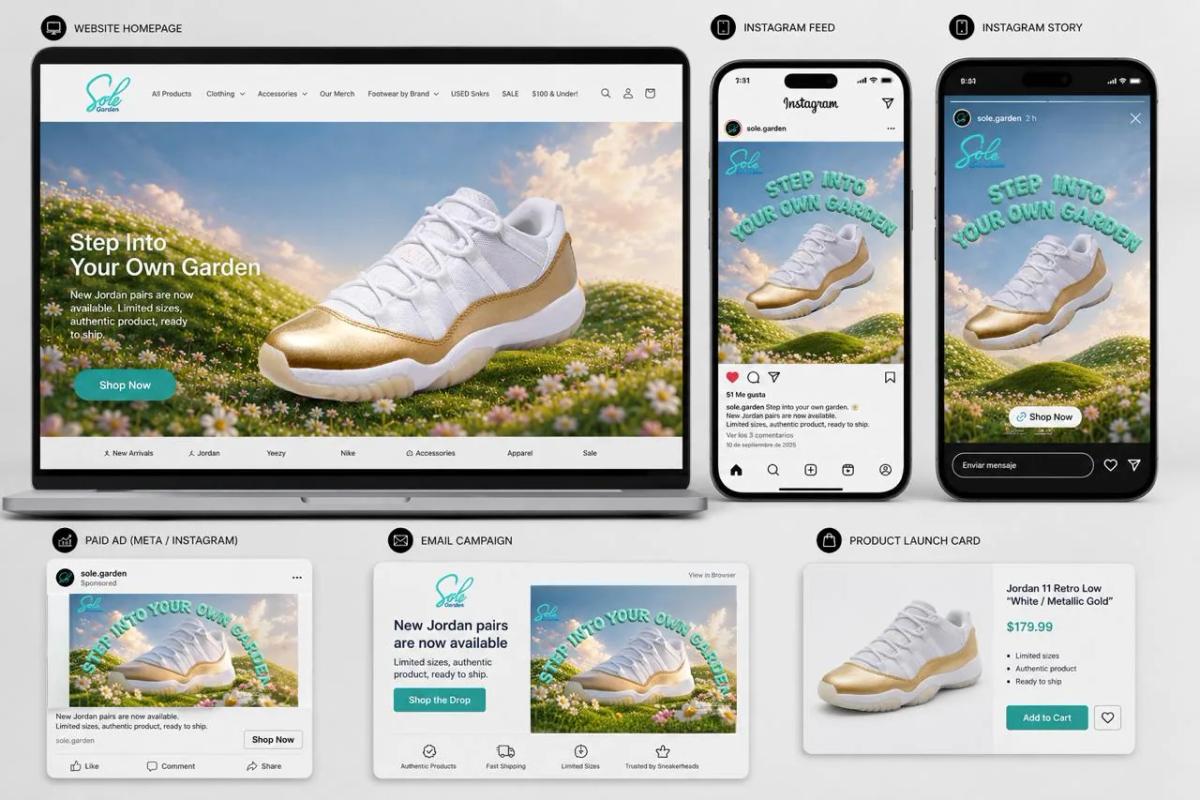
This one goes the other direction, from first impression all the way to the cart. It is for a sneaker retailer called Sole Garden. A white and gold Jordan 11 Retro Low sits on a flower-covered hill under a soft sky. Sneaker retail can feel cold and transactional, so we turned the brand name into a world: Step Into Your Own Garden.
Six surfaces, one world:
- Website homepage. The hero lands the idea, then gives one button and plain facts: new pairs available, limited sizes, authentic product, ready to ship.
- Instagram feed and story. Same world, native formats. The story carries a Shop Now sticker, so a tap goes straight to the product.
- Paid ad. Same creative, tighter copy, built to find new people and send them to the drop.
- Email campaign. For people who already said yes once. One headline, one button (Shop the Drop), and a trust row: Authentic Products, Fast Shipping, Limited Sizes, Trusted by Sneakerheads.
- Product launch card. The closer. Product, price, three bullets, Add to Cart.
Follow it from top to bottom and you land on a checkout button. That is by design.
So How Does This Turn Into Sales?
No magic. Four moves:
- The Read decides who we are talking to. A campaign aimed at everybody is aimed at nobody. We build for the customers the data says actually buy, and the people who look like them.
- One idea, repeated. People need to see something several times before they act. When the billboard, the email, and the product page all look like siblings, each one makes the others work harder.
- Every placement has a job. Awareness surfaces earn attention. Consideration surfaces build desire. Conversion surfaces remove friction. If a piece cannot name its job, it does not ship.
- The path ends at a checkout. Look at the end of both rollouts: a shelf, a Shop Now button, a price, an Add to Cart. The creative is beautiful, but it was built backwards from the sale.
A note on honesty: both of these are rollout concepts, built to show how the system works. There are no results figures here because we do not make those up. When we run this for a client, every placement gets tied to a number it is supposed to move, like reach, click-through, email revenue, or product page conversion, and we report on it.
What You Walk Away With
After a Read, you do not get a deck that dies in a folder. You get a point of view, a campaign idea, the full rollout across every surface, and a clear line from each placement to the result it is supposed to drive.
Want the longer case for why one idea should fan out across many surfaces? Read How to Build Momentum With One Piece of Content. And if you want to see how the data side feeds the creative, start with the Customer Activation Playbook.
Want a Read of your own brand? Get in touch and we will start there.