Why Most Ecommerce Brands Are Marketing to the Wrong Customers
Social commerce just crossed $100 billion in the US. Most brands are distributing their budget across audiences that will never buy twice. Here is what the data actually shows.
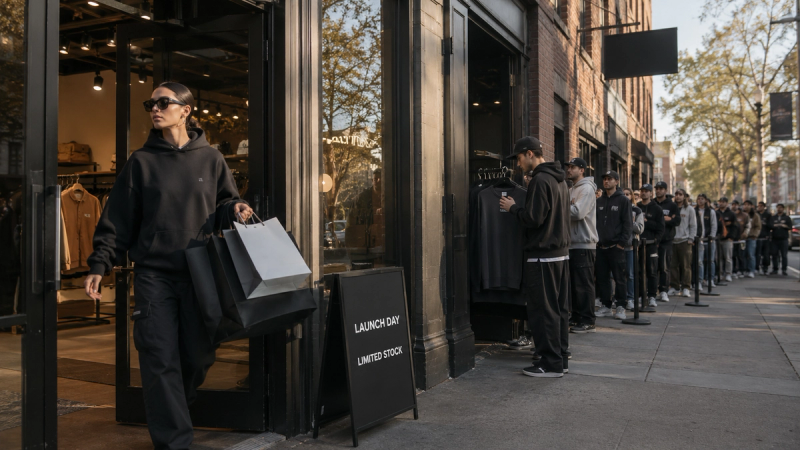
In 2024, a small streetwear brand out of Los Angeles went viral on TikTok. A creator wore their jacket in a video. It hit three million views in 48 hours. Orders came in from 40 countries. The brand sold through its entire inventory in six days.

Six months later, revenue was back to where it had been before the video.
The customers who bought during the spike never came back. They were not streetwear people. They were people who saw something in a feed and clicked. The brand had a moment and mistook it for a market.
This is not an unusual story. It is the defining commercial risk of the current environment, and it is becoming more acute as social commerce grows into a dominant sales channel. The platforms are exceptionally good at putting products in front of people who might buy once. They are structurally indifferent to whether that customer was worth acquiring.
The Revenue Concentration Problem
There is a pattern in ecommerce customer data that appears consistently across qualified brands regardless of category. A small group of customers drives a disproportionate share of commercial outcomes. Not just revenue, but repeat purchase, referral, average order value, and the behavioral data quality that informs everything else the brand does.
For brands up to $10 million in annual revenue, this pattern tends to look something like this: the top 15 percent of the customer base is responsible for 40 to 60 percent of total revenue. When you extend the model to include lifetime value and referral contribution, that same 15 percent often touches 70 to 80 percent of every measurable outcome the brand cares about.

The top 10 percent of an email list typically delivers 50 to 70 percent of email-attributed revenue. Acquisition cost is roughly equal across customer types at the point of conversion, but lifetime value diverges by 5x to 20x within the first 12 months. The top cohort is 8 to 12 times more likely to repurchase within 90 days than the median customer.
This is not a niche finding. It is a structural property of how customer value distributes. Vilfredo Pareto observed it in land ownership data in 19th-century Italy. It shows up in software defects, sales pipeline yields, and employee productivity. In ecommerce, it is observable in customer data at almost every scale we have looked at.
The question is not whether the asymmetry exists. It clearly does. The question is why almost no marketing budget is allocated in proportion to it.
What Social Commerce Is Changing, and What It Is Not
US social commerce sales hit $87 billion in 2025, growing 21.5 percent year over year, and are projected to surpass $100 billion in 2026 for the first time. TikTok Shop alone generated $66 billion in global gross merchandise value in 2025, nearly doubling its 2024 figure, and is projected to reach $112 billion in 2026.
These numbers are real, and they matter. Social commerce has compressed the distance between discovery and purchase to near zero. Live shopping on TikTok converts at 8 to 12 percent, compared to 2 to 4 percent for traditional ecommerce. TikTok Shop's overall conversion rate sits at 4.7 percent, versus 2.1 percent for Instagram Shopping and 1.8 percent for Facebook Shops.
The platforms are, by any conversion measure, extraordinarily efficient at turning browsing into transactions. That efficiency is real and should be taken seriously.
What it does not solve is the underlying problem of who you are converting. A 4.7 percent conversion rate on a broadly distributed audience means a lot of first-time buyers who have no particular affinity for the brand. The average US consumer spends around $1,200 annually through social commerce channels, but that spend is distributed across dozens of brands encountered through the algorithmic feed, not concentrated in the brands those consumers actually care about.
The streetwear brand from Los Angeles was not a victim of a bad TikTok strategy. It was a victim of a structural misunderstanding about what TikTok is. TikTok is a product discovery engine. It is not a brand loyalty engine. The customers who find you there are a mixed signal, and treating every one of them with the same follow-up strategy is the equivalent of treating every lead as if they are equally likely to close.

Short-form video content drives nearly 60 percent of TikTok Shop's total gross merchandise value, while live-streaming generates around 10 percent. The platform is built on impulse and entertainment. That is not an argument against using it. It is an argument for understanding what kind of customer it produces, and which of those customers are worth investing in once the algorithm has done its job.
The Synthesis Problem
Here is what actually happens inside a brand after a social commerce moment like the one above. Shopify has the order data. Klaviyo has the email event data. Meta has the ad interaction data. TikTok has the content engagement data. Each platform knows something. None of them know it is the same person across all four.
The brand is left holding four partial pictures of a customer base it cannot fully see.
Most brands respond to this by doing more: more posts, more email sends, more ad spend. More volume against an audience they do not understand. The signal is buried inside five platforms that have no commercial incentive to talk to each other, and the brand keeps broadcasting into the noise hoping the signal responds.
This is not a data problem. Every brand above a few hundred thousand in revenue has more data than they know what to do with. It is a synthesis problem. The information exists. The pattern that identifies which customers are worth prioritizing is discoverable. What is missing is the act of bringing the data together across systems and reading it as a single coherent picture of customer behavior rather than five separate ones.
The brands that figure out how to do this will have a structural advantage over the ones that do not. Not because they spent more on ads. Because they understood who they were talking to.
Why Creative Precision Has Become the Last Edge
AI generated creative has changed the cost structure of marketing production in ways that are still being absorbed. The execution floor is effectively gone. Any brand can produce ad units, email copy, and social content at a volume that would have required a full agency team three years ago.
The implication is not that creative does not matter. It is that creative quality, defined as production value and execution polish, is no longer the differentiator. If everyone can produce polished creative at low cost, the edge goes to whoever can produce the most precisely targeted creative.
A campaign aimed at the top cohort, written in the psychographic language of the customers who actually respond, outperforms a generic campaign by 30 to 60 percent on conversion. The lift comes from message fit, not from media spend or creative polish.
This is the reason the revenue concentration pattern matters more now than it did five years ago. When creative execution was expensive, broad targeting made economic sense. You produced one campaign and ran it wide because producing a second campaign for a specific audience was cost-prohibitive. That constraint no longer exists. The production cost of making something specifically for your best customers is approximately the same as making something for everyone.
The only reason not to do it is not knowing who your best customers are.
What Social Commerce Actually Rewards
Some sellers report 80 percent of their sales coming from TikTok Shop, which sounds like a success story until you ask what happens to those businesses when the algorithm moves on. Platform concentration is a risk that compounds over time. The brands that win across cycles are the ones that use social commerce as an acquisition surface and then convert the right customers into a relationship that does not depend on the algorithm to maintain.
73 percent of US Gen Z shoppers say social media is their main source for learning about new products, and that is genuinely significant for brand discovery. But discovery is the beginning of a funnel, not the outcome of one. The question is what happens after discovery, and specifically which discovered customers are worth the investment to retain.
The brands that will build durable businesses on social commerce are not the ones who master the content format. The content format advantage has a shelf life measured in months. They are the ones who use the discovery surface to identify which customers, out of the ones who found them through the feed, look like the 15 percent they should be building around.
That is a different problem than going viral. It requires understanding customer behavior at a depth that no single platform provides, and it requires that understanding to translate into a concrete decision about where to direct creative energy and follow-up investment.
A Pattern Worth Watching
We are in early stages of formalizing a framework at Nufero for exactly this problem, working from real customer data across brands we have worked with and observed. It will be detailed properly in a future piece once the research is complete.
What I can say now is that the brands that navigate the current environment well share a common behavior pattern. They are not the ones spending the most on acquisition. They are the ones who understood their best customers early enough to build everything else around them.
The data infrastructure for that kind of understanding did not exist at accessible price points for qualified brands until recently. It is starting to exist now. The brands that move first will carry an advantage that is very difficult to close once established, because the customer relationships they build compound in ways that algorithmic reach does not.

Social commerce will keep growing. The global market is projected to reach $8.5 trillion by 2030, growing at over 26 percent annually. The brands that are still standing at that scale will be the ones who used the channel to find their people, not the ones who used it to find anyone.
The 15 percent exists inside your customer data right now. Most brands have never looked directly at it.